
Management rarely makes consequential financial decisions without knowing the organization's financial position. They expect to understand what the organization owns, what it owes, what is coming in, what is going out, and where material exposures exist. Water is often managed differently. An organization may know how many cubic meters it withdrew last year, report water consumption, set efficiency targets, track wastewater discharge, or announce replenishment commitments. Yet those numbers alone do not tell leaders where the water came from, what happened to it inside the organization, how much was lost or reused, what was returned to the environment, or what future requirements the organization must support. As water becomes increasingly consequential to operational continuity, investment decisions, supply chain stability, community relations, and environmental performance, leaders need a systematic way to determine their organization's water position.
Water accounting provides that system. It is the structured process of identifying, quantifying, classifying, reconciling, and reporting water flows, stocks, and relevant obligations. A water account explains where water came from, what happened to the water inside the facility, how much was consumed, returned, reused, stored, or lost, and what dependencies and commitments exist within a defined organizational boundary and accounting period. Every useful accounting system begins by defining what is being accounted for. For water, that means establishing both an organizational boundary and an accounting period. The boundary could be a manufacturing facility or a supply chain segment, and the accounting period might be quarterly or annual. By establishing a common boundary and period, organizations can aggregate numbers describing different parts of the system to create a coherent management account that reflects the real physical system.
The account begins with what water enters the organizational boundary and system. Water may come from municipal supplies, groundwater, surface water, rainwater, externally supplied reclaimed water, transferred water, and other sources. It is important for management not only to account for the water volume but also for the characteristics of each water source, such as location, quality, accessibility, reliability, cost, regulatory conditions, and exposure to disruption. This helps to understand water consumption patterns and the structural dependencies behind that use necessary to determine the water position of the organization. For instance, two facilities may each withdraw the same annual volume, yet one may rely on a stable, diversified supply portfolio while the other depends heavily on a stressed aquifer or a single river basin.
The next step is to understand what happens to water inside the organizational boundary. Water moves through production processes, cooling systems, buildings, treatment plants, landscapes, sanitation systems, products, storage facilities, and other operational processes. Organizations therefore need to distinguish among several categories (withdrawal, use,consumption, storage, reuse, recycling, return, and loss) that are often merged in reporting. Given that these categories are different, a robust water accounting system helps to distinguish between gross water requirements, net withdrawals, internal circulation, and true consumptive use. This distinction is essential for identifying where operational improvements can reduce dependency on external water sources and improve efficiency without compromising output.
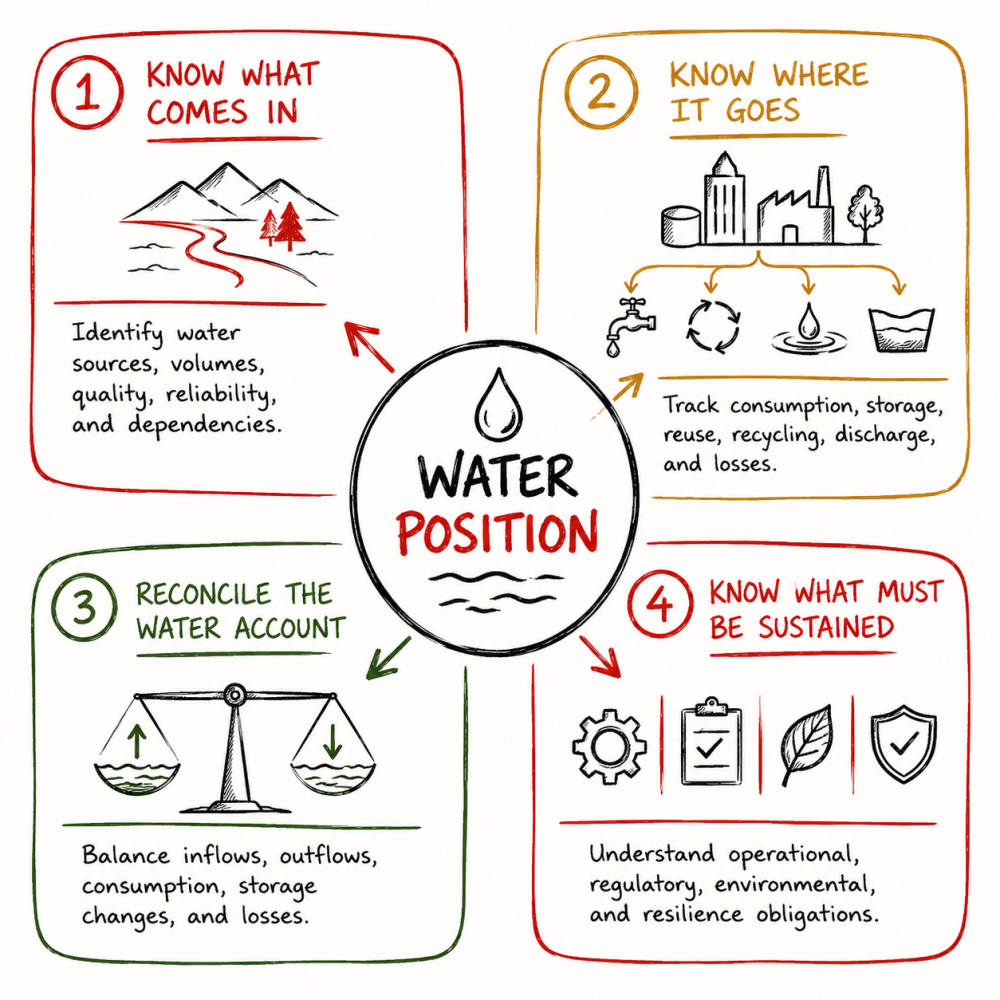
One of the most useful functions of accounting is reconciliation, so the water accounting system, which is a mass balance exercise, should be able to explain the relationship between water entering the system and water leaving, being consumed, stored, or lost. At its simplest, the organizational water balance can be expressed as: Water Inflows = Water Outflows + Water Consumption ± Change in Storage + Accounted Losses.When the two sides do not reconcile, the discrepancy is both a technical error and a signal, showing that something in the water system is not fully understood or properly measured. The gap hindering reconciliation should trigger action to identify the cause, confront uncertainty in the water systems, and improve the quality of their operational knowledge. Whatever the explanation, the discrepancy reveals something important about the organization. A water balance that cannot be explained is evidence that management does not fully understand the water system on which operations depend. Water accounting therefore provides organizational sensing andidentifies where management visibility ends or is needed.
Beyond flows and balances, a credible water accounting system must distinguish between reuse and replenishment. Reuse and recycling reduce dependence on external withdrawals and should be explicitly tracked as internal efficiency mechanisms rather than being hidden within gross consumption figures. Replenishment activities, such as watershed restoration, must also be accounted for separately. These interventions are often reported in aggregate terms, but their real value depends on location, timing, hydrological connectivity, and the methods used to estimate their impact. Without this detail, replenishment claims can become disconnected from actual water system outcomes. Equally important is the concept of water obligations. These include the full set of requirements and regulations an organization must meet to operate responsibly and sustainably. Unlike consumption, which describes past use, obligations describe future constraints and define what the organization must be able to support regardless of internal efficiency gains. A water account that ignores obligations risks underestimating exposure and overestimating flexibility.
When these elements are integrated, the result is an organizational water accounting system that can function as a management instrument. The strategic value of water accounting therefore lies in enabling better decisions. Executives can see what enters the organization, what leaves, what is consumed, what is stored, what is lost, what is reused, what is replenished, and what obligations must be supported. More importantly, they can examine the relationships among those categories. Water accounting creates a defensible baseline for managing risk, improving performance, and planning for uncertainty. Most importantly, it helps management to know the organization's water position and provide the foundation for understanding water solvency.
If your organization knows its water position today, do you know whether that position can sustain its water obligations tomorrow?
Share. Write a Comment. Stay Connected.
Subscribe to the Small Insights, Big Impact. Newsletter for strategic reflections, systems thinking, and leadership insights grounded in real-world experience.
Follow the Small Insights Big Impact page on LinkedIn to stay updated with new content.
Visit www.smallinsightbigimpact.com to explore resources and services.
For inquiries, write to info@smallinsightbigimpact.com
David Tsetse, Ph.D. | SiBI Institute
Subscribe to the Small Insight, Big Impact Newsletter for strategic reflections, systems thinking, and leadership insights grounded in real-world experience.
Subscribe on LinkedIn →